Latest and Greatest – Ethics in the Practice of Elder Law

By Roberta K. Flowers and Rebecca C. Morgan

American Bar Association and the Aba Section of Real Property, Trust and Estate Law

KF 390 .A4 F56 2013

Designed for the attorney who is new to the field of elder law, Ethics in the Practice of Elder Law, provides an overview of the unique ethical issues that may arise when handling matters for elderly clients and for the people who are acting on their behalf. Focusing on the ABA Model Rules of Professional Conduct (rather than individual state rules), the authors examine such topics as identifying the client and the parties to whom the attorney can speak and represent, acting for the client with diminished capacity, recognizing and handling ethical issues in guardianship practice, ascertaining the true client in complex fiduciary representation cases, and dealing with ethical issues during litigation, in the provision of ancillary, non-legal services, and in marketing the elder law practice. In each chapter, you will find a practical question checklist as well as a detailed analysis of the applicable Model Rules. The book also includes the National Academy of Elder Law Attorneys Aspirational Standards, pertinent ABA Ethics Opinions, checklists, and sample letters and notices.

So, if you are new to the practice of elder law or simply need a refresher on your ethical obligations, come to the Harris County Law Library and have a look at Ethics in the Practice of Elder Law as well as some of our other elder law resources, including CLE materials, Texas Elder Law and Elderlaw: Advocacy for the Aging.
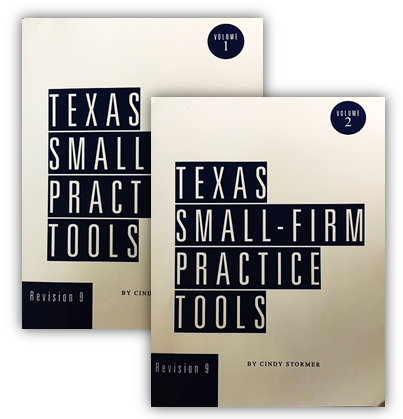
Latest and Greatest – Texas Small-Firm Practice Tools

By Cindy Stormer

James Publishing, Inc. (2015)

KFT 318 .S76

As a small-firm or solo practitioner, you may handle a large variety of cases, thus requiring you to be an expert in many different practice areas. Attorney Cindy Stormer has made your job a lot easier with her book, Texas Small-Firm Practice Tools. Loaded with checklists and over 560 forms, this book focuses on 16 main practice areas, including: civil and business litigation, car accident cases, consumer protection and fair trade practices, landlord-tenant issues, employer-employee relations, credit and collections, small business issues, marriage dissolution, estate planning and administration, criminal defense, and real estate. For each practice area, the author discusses the essential law and procedures with which you need to be familiar and provides you with some useful samples of letters, motions, and client interview questions. It truly is a toolkit for the small-firm or solo lawyer. So, come on down to the Harris County Law Library and find out for yourself how valuable Texas Small-Firm Practice Tools can be to your practice.

Latest and Greatest – Texas Criminal Procedure and the Offender with Mental Illness: An Analysis and Guide

By Brian D. Shannon & Daniel H. Benson

NAMI Texas (2016)

KFT 1766.6 .S52 2016

First published as an educational tool, Texas Criminal Procedure and the Offender with Mental Illness: An Analysis and Guide informed those involved in the criminal justice system of the issues and obstacles faced by persons having a mental illness. Now in its fifth edition, this book, made possible through a grant from the Texas Bar Foundation, continues its mission of promoting justice for mentally-ill individuals by analyzing some of the key issues that arise in criminal cases. The authors devote much of the book to a general discussion of the standards and legislation concerning the competency to stand trial for both adult and juvenile defendants and in cases involving the death penalty. They also examine the insanity defense as it relates to both types of defendants while also looking at various proposals for reform. Lastly, the authors focus on post-conviction issues, such as community supervision, prison or jail mental health care, and completion of the criminal sentence. The book includes detailed and extensive analysis of the pertinent legislation as well as the actual text from the statutes.

Latest and Greatest - Expunction and Nondisclosure

By Andrea Westerfeld

Texas District and County Attorneys Association (2016)

KFT 1792.5 .W47 2016

The Harris County Law Library is excited to have received the 2016 edition of Expunction and Nondisclosure published by the Texas District and County Attorneys Association. This new edition incorporates the many changes that the Texas Legislature made to the nondisclosure laws during the 2015 session. As a result of these changes, there are different requirements for offenses prior to September 1, 2015 and those after September 1, 2015. In addition, the author also documents modifications made to the expunction statute owing to expansions made through case law.

Expunction and Nondisclosure guides you through the process of evaluating whether you or your client is entitled to an expunction and if so, the steps to follow when applying for the expunction. With respect to nondisclosures, the author sets forth the requirements to petition the court for an order of nondisclosure for offenses prior to September 1, 2015 and highlights the new laws applicable to offenses after September 1, 2015. In addition, Ms. Westerfeld also provides the nuts and bolts of the nondisclosure application process. Be sure to look at the appendices as they contain the necessary forms for both expunctions and nondisclosures.

Written in understandable language, this book is useful for both attorneys and pro se litigants. If you’re interested in seeing what the changes are, simply come to the library and ask for Expunction and Nondisclosure at the front desk.

Latest and Greatest - Texas DWI Manual

Picture this: You are comfortably seated in your office with your cup of coffee sorting through your email when the telephone rings. On the other end of the line is a hysterical woman. She has been arrested for DWI. What do you do?

By Deandra M. Grant and Kimberly Griffin Tucker

James Publishing, Inc. (2015)

KFT 1497.8 .G73

For starters, you can visit the Harris County Law Library. It is, after all, Criminal Defense Law Resource Month, and we recently acquired the most recent edition of the Texas DWI Manual published by James Publishing, Inc. This book, complete with forms, will direct you through the initial client interview and the subsequent case investigation and discovery process as well as the administrative driver’s license revocation hearing. In addition, you will learn the elements of a DWI, the various intoxication offenses and their punishment, and the charging instruments used in DWI cases.

Confused by the different field sobriety tests and their admissibility and use at trial? Don’t fret. The authors examine the fundamentals of the DWI breath test and explain how to attack the test and the results on both direct and cross-examination.  In addition, they analyze the methods and strategies involved when using blood alcohol tests as evidence.

Of course, success is not always guaranteed. That is why the authors also discuss punishment options and education and treatment programs as well as error preservation, appeals, and expunctions.

So, before you go ahead and accept that DWI case, be sure to have a look at Texas DWI Manual. It is filled with lots of useful information you will need to competently defend your client. You can find it in our Texas Criminal section or you can ask one of our helpful librarians..