Latest and Greatest – Locating U.S. Government Information Handbook

By Edward Herman and Theodora Belniak

Published by William S. Hein, Co., Inc. (2015)

ZA 5055 .U6 H47 2015

Let’s face it. There is a lot of government information found in print and online, but actually finding it can be quite difficult, not to mention confusing. Here comes Edward Herman’s Locating U.S. Government Information Handbook to the rescue. Designed for the novice researcher, this handbook takes you through a brief introduction about the structure of the United States government and basic online research skills and strategies then on to more specific research sources, such as the indexes published by the Government Publishing Office, U.S. Government maps, historical government documents, and technical reports. There is also some helpful information about how to contact governmental agencies and members of Congress as well as a discussion of the Freedom of Information Act and how to submit requests under the Act.

If you feel overwhelmed by the volume of government information and are not sure how to find answers you are seeking, try Locating U.S. Government Information Handbook. It’s available at the reference desk. Just ask a librarian for assistance.

Poetry of the Bench and Bar: Wills in Verse

Where there's a will, there's a way...with words. Today's featured poetry is a small collection of testamentary documents, carefully crafted expressions of the authors’ last wishes and bequests. Much like the lyrical legal opinions currently on exhibit in the Library lobby, these wills are some of the more eloquent and engaging legal statements on record.

Published in the 19th century as part of the Legal Recreations series, the wills featured in J. Greenbag Croke's 1884 Lyrics of the Law were authored by men for whom poetry was, at most, an avocation, yet the thoughtful and creative declarations expressed in this collection of wills are truly inspired.

For at least one author, that inspiration appears to have been less poetic than polemic. With a sharp tongue (at least partly in cheek), Lord William Ruffell, Esq. of Suffolk, England begins his last will and testament by disparaging those with whom he shared a profession.

The Will of William Ruffell, Esq. (1803)

I make this my last will, as I think ‘tis quite time,
It conveys all I wish, though ‘tis written in rhyme,
To employ an attorney I ne’er was inclin’d
They are pests to society, sharks of mankind.
To avoid that base tribe my own will I now draw,
May I ever escape coming under their paw.

This poem is just one of several wills set to rhyme, which are, in turn, only a sample of the various poetic forms that exist in legal verse. As the Library continues to celebrate National Poetry Month, we will share a new example of legal verse each Friday in April. 


Legal Writing Resources Month

April is Legal Writing Resource Month at the Harris County Law Library. Whether you are an attorney drafting a motion or a self-represented litigant navigating the court system, writing is a necessary component of your legal work. Visit the Law Library all month long to find resources on display that you can use to improve and enhance your legal writing skills. Resources include:


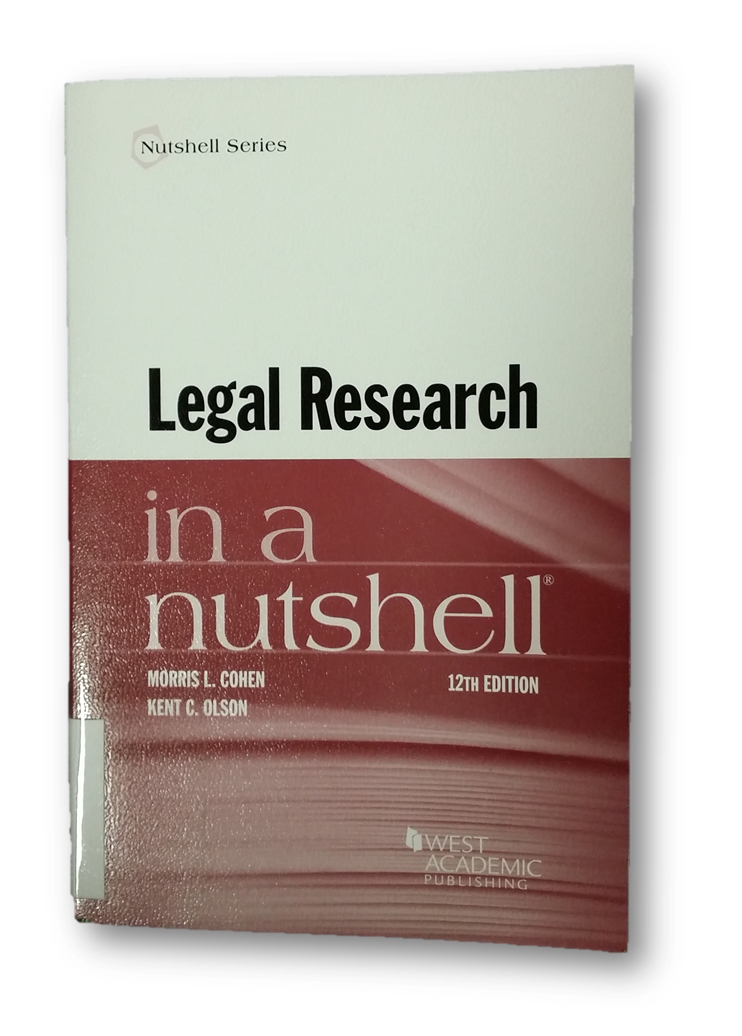
Latest and Greatest - – Legal Research in a Nutshell

By Morris L. Cohen & Kent C. Olson

Published by LEG d/b/a West Academic Publishing (12th Edition 2016)

KF 240 .C54 2016

Intimidated by the thought of having to research a legal issue? Not sure how or even where to begin?

Well, you’re not alone. Legal research is a lot more than simply entering some keywords into the search box of a Web browser. It requires an understanding of the research process itself as well as the types of resources commonly used to locate legal information. Legal Research in a Nutshell explains the legal research process and the forms and sources of legal information. You will become familiar with and learn how to locate case law, statutes and constitutions, legislative information, administrative law, and court rules and practice. There is also discussion of specialized and nonlegal resources, such as looseleaf services, legal newspapers, blogs, statistics, and legal directories. If your research is taking you global, don’t fret because the authors also address international law and the laws of other countries.

You can access some of the great features offered by this book on its companion Website through the library’s catalog. Simply click on the “earth” icon at the end of the catalog record under the Media heading and enjoy entering the world of legal research.