Latest and Greatest – Ethics in the Practice of Elder Law

By Roberta K. Flowers and Rebecca C. Morgan

American Bar Association and the Aba Section of Real Property, Trust and Estate Law

KF 390 .A4 F56 2013

Designed for the attorney who is new to the field of elder law, Ethics in the Practice of Elder Law, provides an overview of the unique ethical issues that may arise when handling matters for elderly clients and for the people who are acting on their behalf. Focusing on the ABA Model Rules of Professional Conduct (rather than individual state rules), the authors examine such topics as identifying the client and the parties to whom the attorney can speak and represent, acting for the client with diminished capacity, recognizing and handling ethical issues in guardianship practice, ascertaining the true client in complex fiduciary representation cases, and dealing with ethical issues during litigation, in the provision of ancillary, non-legal services, and in marketing the elder law practice. In each chapter, you will find a practical question checklist as well as a detailed analysis of the applicable Model Rules. The book also includes the National Academy of Elder Law Attorneys Aspirational Standards, pertinent ABA Ethics Opinions, checklists, and sample letters and notices.

So, if you are new to the practice of elder law or simply need a refresher on your ethical obligations, come to the Harris County Law Library and have a look at Ethics in the Practice of Elder Law as well as some of our other elder law resources, including CLE materials, Texas Elder Law and Elderlaw: Advocacy for the Aging.

Access to Justice, New and Noteworthy Items Around the Web

Today’s blog post is a look at resources around the Web. What services exist for those in need of civil legal aid? Who is working in Texas and across the nation to provide these services, and what can be done to further their cause? What alternatives to traditional legal aid already exist and which efforts are most successful? Do law schools, legal clinics, and incubator programs have a role to play? How can technology be employed to help self-represented litigants navigate the justice system? And what is driving this increasingly dire need for legal services to the poor? What can be done to help?

The Harris County Law Library has compiled this brief list of resources to help answer these questions. We invite you to explore the topic further. We will update this list with subsequent blog posts in the near future, making sure to provide the latest coverage about this growing area of concern.

Organizations - Texas

Texas Access to Justice Foundation

TexasLawyersHelp.org

TexasLawHelp.org

Texas Legal Services Center

LegalAidResearch.org

Organizations - National

National Center for Access to Justice

National Coalition for a Right to Civil Counsel

National Legal Aid and Defender Association

Public Welfare Foundation

Self-Represented Litigation Network

Recent Media Coverage

Access to Justice: Is Civil Gideon a Piece of the Puzzle?

The Defenders: What does the future of legal services for the poor look like?

How to Solve the Housing Crisis: More Lawyers

Lawyers: Bulwark against Inequality and Gentrification?

Legal Aid With a Digital Twist

One More Way the Courts Aren’t Working for the Poor

States Look to Provide Lawyers for the Poor in Civil Cases

Recently Published Reports

Blazing a Trail: The Fight for Right to Counsel in Detention and Beyond

The Justice Index 2016

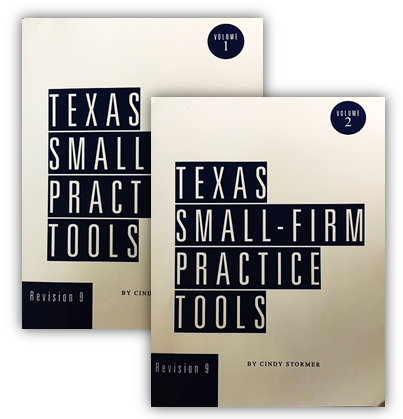
Latest and Greatest – Texas Small-Firm Practice Tools

By Cindy Stormer

James Publishing, Inc. (2015)

KFT 318 .S76

As a small-firm or solo practitioner, you may handle a large variety of cases, thus requiring you to be an expert in many different practice areas. Attorney Cindy Stormer has made your job a lot easier with her book, Texas Small-Firm Practice Tools. Loaded with checklists and over 560 forms, this book focuses on 16 main practice areas, including: civil and business litigation, car accident cases, consumer protection and fair trade practices, landlord-tenant issues, employer-employee relations, credit and collections, small business issues, marriage dissolution, estate planning and administration, criminal defense, and real estate. For each practice area, the author discusses the essential law and procedures with which you need to be familiar and provides you with some useful samples of letters, motions, and client interview questions. It truly is a toolkit for the small-firm or solo lawyer. So, come on down to the Harris County Law Library and find out for yourself how valuable Texas Small-Firm Practice Tools can be to your practice.