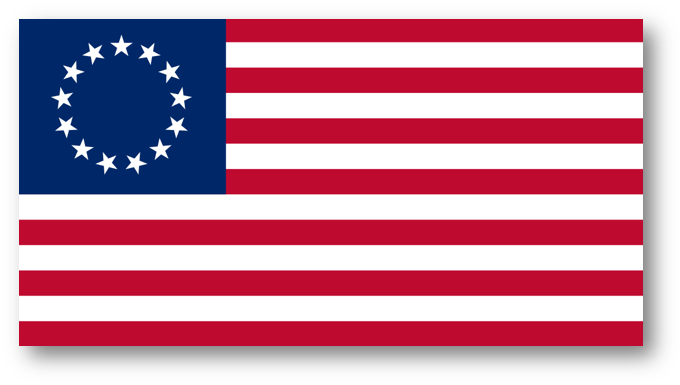
On this day in 1777, nearly two and a half centuries ago, the Stars and Stripes (pictured at right) was adopted as our national flag. While the Second Continental Congress was meeting in Philadelphia to draft the Articles of Confederation, the assembly interrupted its task to pass a resolution. It stated that “the flag of the United States be 13 stripes, alternate red and white” and that “the union be 13 stars, white in a blue field, representing a new constellation.”
This design differed greatly from an existing banner, the Continental Colors, which was promoted by George Washington early in the Revolutionary War as our unifying flag. It featured alternating red and white stripes for the 13 colonies and a British Union Jack in the upper left-hand corner, a design which reflected the ideological factions of the time -- radicals eager to claim independence and loyalists still hoping for some harmony with the crown. To proclaim its coveted sovereignty, however, the Continental Army needed a more appropriate symbol, an emblem that would unify its effort for independence, hence the design and adoption of the Stars and Stripes (also known as the Betsy Ross Flag) on June 14, 1777.
As the country grew, the flag kept pace. New stars were added for each new state in the Union, until, at the dawn of World War I, the flag's design contained 48 stars. Once again, it served as a unifying symbol for the American people, some of whom sympathized with Britain and France and others who favored Germany. In an effort to heal the growing division within our nation, and to prevent polarization of sentiment, President Woodrow Wilson, issued Proclamation 1335, which established the celebration of Flag Day as June 14th:
Many circumstances have recently conspired to turn our thoughts to a critical examination of the conditions of our national life, of the influences which have seemed to threaten to divide us in interest and sympathy, of forces within and forces without that seemed likely to draw us away from the happy traditions of united purpose and action of which we have been so proud, It has therefore seemed to me fitting that I should call your attention to the approach of the anniversary of the day upon which the flag of the United States was adopted by the Congress as the emblem of the Union, and to suggest to you that it should this year and in the years to come be given special significance as a day of renewal and reminder, a day upon which we should direct our minds with a special desire of renewal to thoughts of the ideals and principles of which we have sought to make our great Government the embodiment.
Happy Flag Day!