

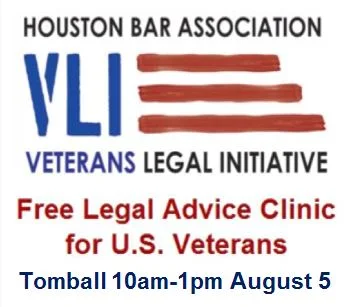
Veterans who need legal advice or legal assistance can visit a free legal clinic on Saturday, August 5, from 10:00 a.m. until 1:00 p.m., at the Tomball VA Outpatient Clinic, 1200 W. Main Street, Tomball, TX 77375. The clinic is a public service of the Houston Bar Foundation’s Veterans Legal Initiative and will be held in conjunction with a free Veterans Benefits Fair sponsored by the Texas Veterans Commission, the Veterans Land Board and the Department of Veterans Affairs.⠀
⠀
No appointment is necessary. Any veteran, or spouse of a deceased veteran, can receive advice and counsel from a volunteer attorney in any area of law, including family, wills and probate, consumer, real estate and tax law, as well as disability and veterans benefits. Veterans who need ongoing legal representation and who qualify for legal aid may be assigned a pro bono attorney to handle their case.⠀
⠀
For more information on the August 5th clinic and other services for veterans, contact the Veterans Legal Initiative at 713-759-1133 or visit HBA VLI online
We've Come a Long Way Abe-y!

In recent days, stories about coins and other currencies have been appearing in the news: a coin collector has all but confirmed the authenticity of the first coin ever minted in the United States; the Abraham Lincoln penny, which debuted on August 2, 1909, celebrated its anniversary; the Bitcoin split in two; and the Venezuelan bolivar was calculated to be less valuable than the currency used in World of Warcraft. With today's blog post, we're continuing the trend with a discussion of coins old and new.
Since the release of the Abe Lincoln penny more than a century ago, simple coinage has evolved dramatically. These physical objects that we trade for goods and services still hold value as legal tender, but in some circles cryptocurrencies such as Bitcoins are becoming a more widely preferred unit of exchange. Serving as alternatives to traditional forms of money, these cryptocurrencies are intangible strings of computer code, executed on a distributed ledger or blockchain, to be transferred between virtual parties in the digital realm. According to speculators, the buying and selling of cryptocurrencies is quite lucrative, prompting the government to formally consider whether or not U.S. federal securities laws should govern their trade. In a Report of Investigation released last Friday, the SEC determined that offers and sales of digital assets by virtual organizations are indeed securities and therefore subject to the requirements of the federal securities laws. Of course, pennies and other minted metals (along with banknotes) are still the primary forms of currency in use today, and they will be for the foreseeable future, but the idea of transacting business using a secure, anonymous, decentralized alternative to traditional coins and bills has many supporters. Increasingly, the legal industry is among them, and Agrello is one of the first players at the table.
Created by a group of Estonian lawyers, academics, and technology experts, Agrello is a pioneer in the legal tech field. (It's no surprise that Estonians are leading the charge. The small but impressive country has fully embraced digital life by building an efficient, cost-effective, entirely digital government infrastructure that warrants a closer look.) This innovative company seeks to transform the practice of law using artificial intelligence as a tool for facilitating digital agreements over the Internet. These smart contracts have the potential to radically change how business is conducted, as well as the monetary model on which it will rely. Just weeks ago, Agrello announced an initial coin offering (ICO) for its own cryptocoin called Delta, which, according to the token utility paper published on the company's blog, "will be required to employ the Agrello platform and to perform various actions in the system, such as the deployment of new agreements or the usage of blockchain and contract repository resources." The Delta token sale started on July 16th, but for the time being, "US nationals are excluded from participating in the sale." Regardless, tracking the progress of cryptocurrencies and blockchain technology will be interesting, especially as these new tools are used to shape the practice of law. At least for now, however, a penny saved is still a penny earned.
Nolo Press in Print and Online + Other Self-Help Resources for Pro Se Litigants


Navigating the law, especially for the non-lawyer, can be daunting, confusing, and frustrating. We at the Harris County Law Library provide resources and information that, we hope, make the law less intimidating and more accessible to the general public. One of the best, most indispensable tools for those who need to get acquainted with a new area of the law is a collection of books from Nolo Press, a publisher of legal materials, written in plain English, on a wide variety of legal topics. Designed to assist self-represented parties in learning about the law, Nolo Press is a company that seeks to “make the law accessible to everyone."
In addition to the Nolo Press publications, the Harris County Law Library's self-help collection contains a number of accessible, user-friendly resources including the Nutshell series from West publishing and the Texas Young Lawyers Association Research Guides for the general public. Nutshells are concise, one-volume treatises that address a particular area of the law, and the TYLA guides provide very practical information for handling specific legal matters in Texas, including probate, CPS cases, guardianship, and divorce.

The Nolo collection is a bit more expansive, as it covers all of the following topics and more: bankruptcy, criminal law, immigration, family law, labor and employment, landlord-tenant, estate planning, and social security. Other titles address how to start a small business, file a suit in small claims court, repair your credit, dispute a traffic ticket, survive foreclosure, and win a personal injury claim.
If you are unable to visit the Law Library in person, there are several options for accessing self-help legal resources online. The Nolo books, in particular, are available through several channels, including the Harris County Public Library, the Houston Public Library, and the Texas State Law Library online. As members of the TexShare Libraries Consortium, these institutions offer access to the Ebsco Legal Information Reference Center, which provides full-text digital versions of all titles published by Nolo Press, including some titles not included in the Harris County Law Library print collection. (The Texas State Law Library also provides access to the West Nutshell series.) To gain access to this online database, you must have a valid library card for one of the institutions named above. All residents of Texas are eligible to receive a library card, simply by filling out an application in person or by requesting a library card from the Texas State Law Library via the library's web portal.
Fastcase 50 Honorees

Earlier this month, the legal research platform, Fastcase, announced its annual class of innovators, techies, visionaries, and leaders. Known as the Fastcase 50, the honorees are a distinguished group of lawyers, legal technologists, policymakers, judges, law librarians, and bar association executives. They are people from all walks of life whose accomplishments in the field of law inspire others to advance the profession.
In recent years, Texas has been well represented among those selected, and 2017 is no exception. Cameron Vann, Senior Staff Attorney of the State Bar of Texas Lawyers' Assistance Program is a recent inductee as is Cisselon Nichols Hurd, Senior Counsel at Shell Oil and Co-Founder of the UT Center for Women in Law.
Also included among the honorees since 2011 are several librarians. Carla Hayden, 14th Librarian of Congress, is on this year's roster. Previous librarian inductees are listed here.
2016: Tim Baran, Cathryn Bowie, Robert (Bob) Oaks
2015: David Mao, Kate Martin
2014: Tina Gheen, Courtney Kennaday, Richard Leiter
2013: Bob Berring, Jr., Cindy Chick, Anne Ellis, Bess Reynolds
2012: Tom Boone, Jason Eiseman, Jane Kinney , Roger Skalbeck
2011: Robert Brink, Tom Bruce, Sarah Glassmeyer, Joe Hodnicki, John Joergensen, John Palfrey, Rob Richards, Roberta Shaffer, David Whelan, Judith Wright
New On-Demand Video CLE: Excel Essentials for the Practice of Law


The Legal Tech Institute at the Harris County Law Library has just released a new video CLE. Excel Essentials for the Practice of Law is the latest addition to our Learning On-Demand CLE library, where you can earn CLE credit in Texas while staying up to date on legal tech. Visit the Law Library's Legal Tech Institute page for more on our legal tech learning opportunities.
