


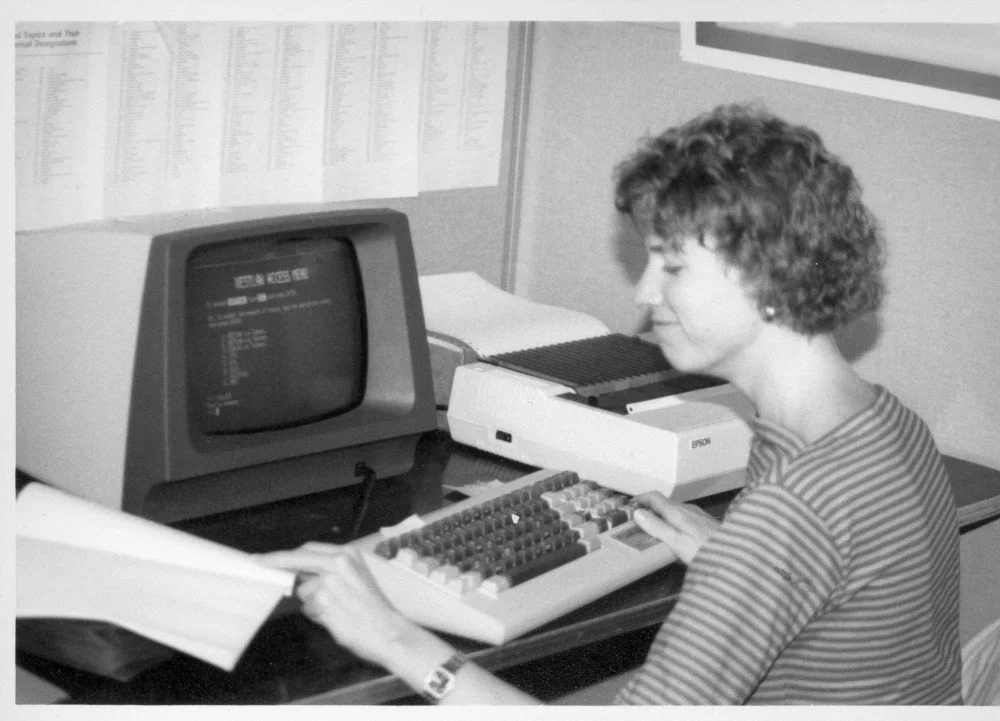
A student is shown here using one of the first Westlaw terminals in 1981. Image Source: Lewis & Clark Law School
In 2026, the Harris County Robert W. Hainsworth Law Library commemorates the 40th anniversary of WALT — the West Automated Legal Terminal — a pioneering technology that marked the Library’s entry into the world of online legal research and helped reshape how attorneys, judges, and self-represented litigants access the law.
The Law Goes Online
The concept of computerized legal research first emerged in the early 1970s with Mead Data Corporation’s Lexis database. In 1975, West Publishing — long the dominant force in print legal materials — launched Westlaw, signaling that legal research was entering a new technological era.
Unlike today’s browser-based platforms, early systems required dedicated, proprietary terminals connected by telephone lines. These terminals were not optional accessories; they were the only gateway to the databases.
WALT Arrives in Harris County (1986)
In 1986, the Harris County Law Library introduced Westlaw access through a terminal known as WALT (West Automated Legal Terminal). For many local practitioners, this was their first encounter with computerized legal research.
Despite its novelty, WALT coexisted with the Library’s extensive print collection:
Electronic databases contained far less content than they do today.
Searches were billed by time, and costs could reach $150 per hour, making efficiency essential.
Many researchers still relied on books for initial work, turning to WALT for targeted searching.
Even so, WALT represented something revolutionary: instant retrieval of authorities that previously required hours of manual searching.
A Shift in How Lawyers Worked
WALT did more than introduce a new research tool — it changed legal workflows.
Before WALT:
Research meant moving physically through rows of reporters, digests, and pocket parts.
Updating case law required careful manual checking.
Access to comprehensive research tools depended heavily on the size and resources of a firm.
With WALT:
Researchers could locate cases across jurisdictions in minutes.
Keyword searching supplemented the traditional West Key Number System.
Updating authorities became faster and more reliable.
Solo practitioners gained capabilities once limited to large firms with extensive libraries.
For Harris County’s legal community — particularly small firms and independent attorneys — this democratization of research power was transformative.
Early Technology, Lasting Impact on Access to Justice
Although expensive and limited by today’s standards, WALT played an important role in expanding access to justice.
Public law libraries like ours became essential access points where:
Attorneys without large research budgets could conduct sophisticated searches.
Pro se litigants gained exposure to tools previously unavailable outside private practice.
Librarians began developing new roles as technology guides and research instructors.
In many ways, WALT foreshadowed the Library’s modern mission: ensuring that access to legal information does not depend on economic resources.
From Dedicated Terminals to Ubiquitous Access
Over the next four decades, legal research technology evolved rapidly:
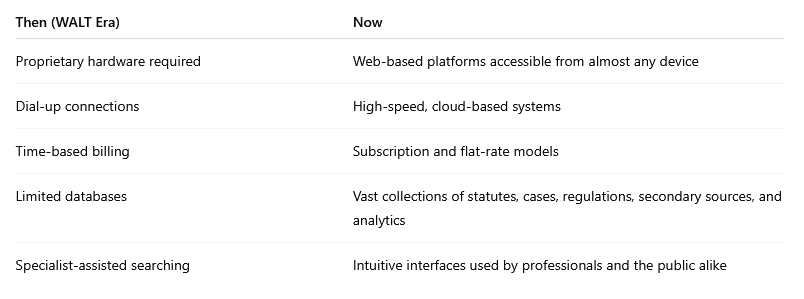
Today’s legal research environment — searchable, interconnected, and widely accessible — rests on the technological foundations laid by systems like WALT.
The Library’s Role in a Continuing Evolution
The Harris County Law Library’s adoption of WALT in 1986 demonstrated an early commitment to embracing innovation in service of the legal community. That same commitment continues today through:
Providing public access to modern legal databases
Teaching research skills to attorneys and self-represented litigants
Bridging the digital divide in legal information
Supporting efficient, informed practice across Harris County
WALT may now seem like a relic of another technological age, but its introduction marked the beginning of a transformation that still shapes how justice is researched, practiced, and understood.
For additional historical perspective on WALT and early Westlaw technology, see Deborah E. Shrager, Saying Farewell to a Classic, AALL Spectrum (Dec. 2014). Also, view the Harris County Law Library’s Digital Exhibit: Legal Tech Evolution for a timeline of events in the development of technology leading up to the current era.