


Constitution Day is observed each year on September 17 to commemorate the signing of our Constitution in 1787. On display in the Law Library lobby throughout the month of September is an exhibit featuring foundational documents that shaped the Constitution, including the Declaration of Independence and the Articles of Confederation, along with examples of broadsides that were crucial to the states’ decisions to ratify our founding document.
Remembering 9/11: National Archives 9/11 Commission Records

Today, we remember the tragedy of the terror attacks that fell the World Trade Center Towers in New York City on September 11, 2001. As nearly two decades have passed, the details of the day may have faded from memory even as the pain suffered by those who lost loved ones as the towers fell stings just as sharply. Preservation of the details to remind us of this pivotal event in American history is, therefore, important.
The job of investigating the details was originally assigned by Congress (see Pub. L. 107-306) to the National Commission on Terrorist Attacks Upon the United States, which became known as the 9/11 Commission. The records generated by the investigation are now entrusted to the National Archives, which makes the details of the day forever committed to our nation’s memory.
Find more information about the 9/11 Commission Records at https://www.archives.gov/research/9-11.
Happy Women's Equality Day!
Today, August 26, is Women's Equality Day. The date commemorates the passage of the 19th Amendment to the U.S. Constitution, which guarantees women the right to vote. It states that "the right of citizens of the United States to vote shall not be denied or abridged by the United States or by any State on account of sex."
Women’s Equality Day was established at the behest of Congressional Representative, Bella Abzug (D-NY), to observe women’s suffrage and to recognize the contributions of women throughout history. This day of recognition also celebrates women’s accomplishments in public and private spheres.
For resources on Women's Equality Day, visit the National Women's History Museum online.
LTI CLE: Legal Tech is Not Optional

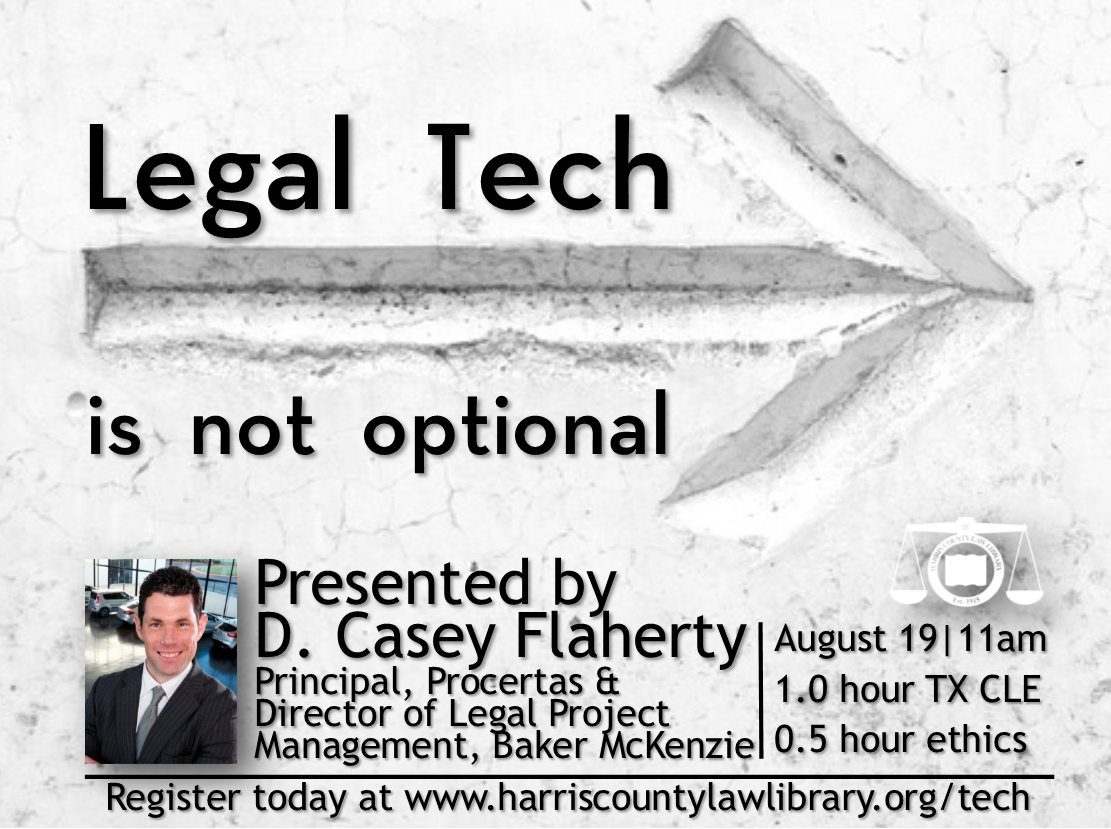
The Harris County Law Library’s Legal Tech Institute is pleased to announce a special visitor, D. Casey Flaherty, a recognized leader in legal tech innovation and the creator of the Procertas legal tech audit. Please join us on Monday, August 19 and 11:00 am for a CLE presentation called Legal Tech is not optional. Mr. Flaherty will share his insights about using technology in the practice of law and will highlight how the Procertas Legal Tech Assessment, which is available to all for free at the Harris County Law Library, can help attorneys work toward legal tech competence. Texas attorneys will earn one hour of CLE credit and .5 hours of ethics credit for attending. Join us!
Space Law - Apollo 11 Moon Landing, 50th Anniversary

Saturday, July 20, 2019 was the 50th anniversary of the Apollo 11 Moon Landing. Here in Space City, we’re marking the event with an exhibit, currently on display in the Law Library lobby, a digital exhibit on The Law of Space, and a compilation of resources from the Harris County Law Library’s print collection. Included are a number of primary law materials (listed below) and related visual content, which you can find on NASA’s Jet Propulsion Laboratory website and download for personal use.
The National Aeronautics and Space Act of 1958, contained in the United States Statues at Large, Pub. L. No. 85-568, 72 Stat. 426-438, established NASA and marked America’s official entry into the Space Race.
The Code of Federal Regulations, Title 14: Aeronautics and Space details the purpose, function, and organization of NASA as mandated by Congress.
To accommodate the large number of astronauts who live in Texas, the Secretary of State adopted special rules, spelled out in the Texas Administrative Code §81.35, that authorize NASA to implement procedures for casting ballots in outer space.
The Outer Space Treaty, the multilateral agreement that established the governance of state activities in the exploration and use of outer space, was signed by more than 100 countries. It was first proposed by the United Nations Committee on the Peaceful Uses of Outer Space in August of 1966, making this the 50th anniversary of its conception.
Article I, which captures the spirit of the Outer Space Treaty, is excerpted here. As we recognize this sentiment of equality, good will, adventure, and cooperation, the Harris County Law Library invites you to explore our resources. Plan your visit today!
“The exploration and use of outer space, including the moon and other celestial bodies, shall be carried out for the benefit and in the interests of all countries, irrespective of their degree of economic or scientific development, and shall be the province of all mankind.
Outer space, including the moon and other celestial bodies, shall be free for exploration and use by all States without discrimination of any kind, on a basis of equality and in accordance with international law, and there shall be free access to all areas of celestial bodies.
There shall be freedom of scientific investigation in outer space, including the moon and other celestial bodies, and States shall facilitate and encourage international co-operation in such investigation.”
Additional resources have been previously reviewed on Ex Libris Juris as Latest & Greatest features.