

Writs. We’ve all heard of them. There’s the writ of certiorari, the writ of habeas corpus, and the writ of mandamus, just to name a few. But what exactly is a writ and what does it do? Simply put, a writ is “an order issued by a legal authority with administrative or judicial powers, typically a court.” Historically, in the common law, writs were used to convey real property, grant privileges or rights, and to convey information. They were also written executive directives from the king, instruments by which the king could intervene into matters that were not resolved by feudal courts. Later, writs evolved, adopting a more judicial nature, acting as summonses or the initial documents in legal matters or as an order commanding a person to do something or refrain from doing something.
Read moreFilm Screening: Not Your Model Minority
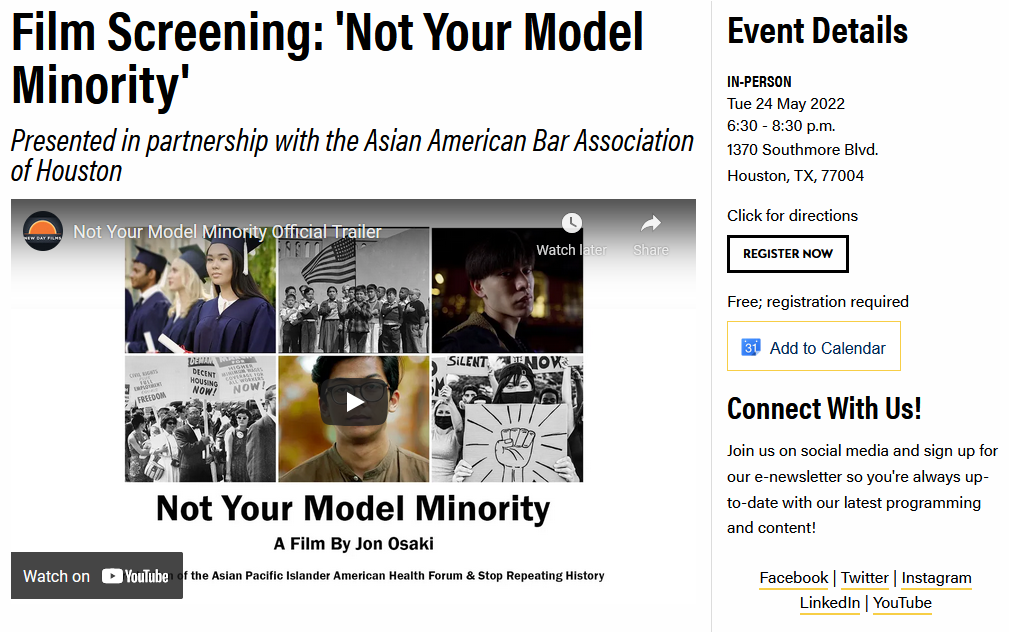
Tomorrow, Tuesday, May 24, Asia Society Texas, in partnership with the Asian American Bar Association in Houston, will present a film by award-winning filmmaker, Jon Oaski. This documentary, entitled Not Your Model Minority, explores the historic and cultural roots of the model minority myth imposed on Asian Americans and Pacific Islanders in academic, professional, and political contexts.
Read moreGideon’s Legacy

On March 18, 1963, the United States Supreme Court ruled in Gideon v . Wainwright that the Sixth Amendment’s guarantee of counsel in criminal cases is a fundamental right, essential to a fair trial, as provided by the Due Process Clause of the Fourteenth Amendment to the United States Constitution. The court battle leading up to this ruling was truly a case of David v. Goliath. In recent years, there has been a push to advocate for a “Civil Gideon” – the right to legal counsel in civil cases. If Civil Gideon should ever come to pass as a universal Constitutional right, the legacy of Clarence Earl Gideon, whose own case was decided on this day 59 years ago, would be fulfilled for all so that “justice should be the same, in substance and availability, without regard to economic status” and irrespective of the type of offense.
Read moreLegal Visionary Rev. Dr. Pauli Murray and the Fight Against "Jane Crow"
Civil rights and women’s rights activist, lawyer, scholar, poet, and Episcopal priest Rev. Dr. Pauli Murray was the first to use the term “Jane Crow” to describe the racism and misogyny African-American women faced in the post-Reconstruction era leading up to the civil rights movement. Their* work and activism helped shape legal ideas and arguments for gender and racial equality in the decades leading up to the civil rights movement.
Read moreFree Virtual CLE - 80 Years Later: The Legacy of Japanese American Incarceration and Korematsu v. The United States
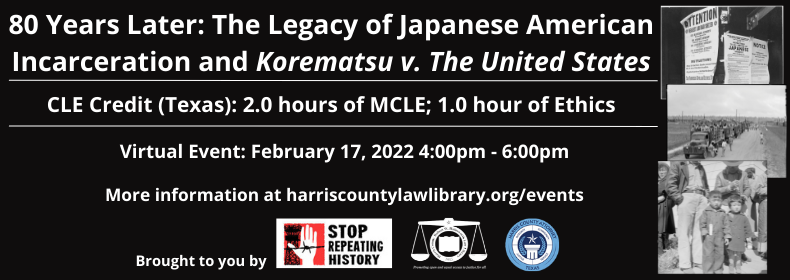
Join us Thursday, February 17, 2022, for a virtual CLE called “Free Virtual CLE - 80 Years Later: The Legacy of Japanese American Incarceration and Korematsu v. The United States.” This program begins with a screening of “Alternative Facts: The Lies of Executive Order 9066,” a one-hour documentary about the false information and political influences which led to the World War II incarceration of Japanese Americans. This documentary also depicts the process undertaken to overturn Fred Korematsu’s conviction for violating an internment order in Korematsu v. The United States. After the screening, panelists will discuss the making of the film, the history of Korematsu v. The United States, the role of state judiciaries in protecting individual rights, and the importance of civic engagement. CLE Credit (Texas): 2.0 hours of MCLE; 1.0 hour of Ethics
Read more