

Join us for a free Lexis Advance training session on Thursday, May 12, noon to 1pm. For details and RSVP information, download the flyer below.

Westlaw CLE @ HCLL

On Thursday, March 31, the Law Library will host a free Westlaw training session covering Statutory and Legislative History Resources. The session carries 1.0 hour of CLE credit for Texas attorneys and is conveniently scheduled during the lunch hour, from noon to 1 p.m. Visit our Events page for more details.
The Law Library hosts Westlaw training sessions quarterly. For more information about CLEs and training sessions at the Harris County Law Library, visit our Events page.
All of the databases covered during training sessions are accessible for free on the Law Library’s legal research computers, which are open to the public for legal research. Visit Our Services page for more information about the digital resources available for your legal research needs.
Using Styles to Format Appellate Briefs


According to the Texas Rules of Appellate Procedure, briefs must follow very specific formatting conventions. Spelled out in Rule 38, these conventions ensure that all appellate briefs are consistently uniform in appearance, organization, and theme. Meeting these specifications fulfills the requirements of the court, conveying not only compliance with court rules but professionalism and credibility.
Formatting can be a time consuming and sometimes frustrating process, but drafting documents in Microsoft Word, taking full advantage of its built-in tools, simplifies the process considerably. The Styles feature, which is often overlooked by even the most proficient MS Word users, is one such time-saving tool.
A Style is a collection of formatting instructions, applied consistently throughout a document to standardize the font, titles, spacing, paragraphs, headings, and sections. Using Styles to create a document template, you can cleanly and properly format your briefs, substantially transforming the draft-writing process to one of ease and efficiency. Due to the cascading effect of Styles, any one title or heading is formatted just like all of its kind. Therefore, one minor change in some basic feature of the text, particularly one that repeats throughout your brief, is no longer a source of aggravation and wasted effort. And Styles are an excellent remedy for the frustration of formatting your tables of contents and tables of authorities as well. For a useful resource guide, see Georgetown Law School's Styles, Tables of Contents, and Tables of Authorities in Microsoft Word 2010.
Digitized Historical Texas Statutes from the Texas State Law Library

Earlier this month, the Texas State Law Library announced a new collection of digitized historical Texas statutes available on its website. The collection now includes all Texas statutes from 1879 to 1960. The newest content includes works with copyrighted material published between 1928 and 1960, which is now available under an agreement with the copyright holder Thomson Reuters and in collaboration with the Austin Bar Foundation, which provided a grant to fund digitization. Visit the Historical Texas Statutes page on the Texas State Law Library website to learn more and to download copies of these newly-digitized, searchable documents.
Minding the Gap
Despite the Texas State Law Library’s giant leap forward in making historical Texas statutes available online, there is still a gap practitioners must keep in mind. Thomson Reuter’s Westlaw provides access to historical statutes back to 1987, which is likely to cover most researcher’s needs. However, a criminal defense attorney might need to know the language of a 1985 DWI statute to determine its effect on a client's sentence, or a real estate attorney may need to read a probate statute from the 1970s to see how it will impact a title in a pending sale. When research falls into the gap, the Harris County Law Library is here to help. We have historical statutes and legislative history materials to help you reconstruct historical Texas statutes and we provide free access to Westlaw on our legal research computers for your 1987-to-present research needs. Visit the Law Library any time we can assist with your historical Texas statutory research.
Lexis Advance CLE @ HCLL
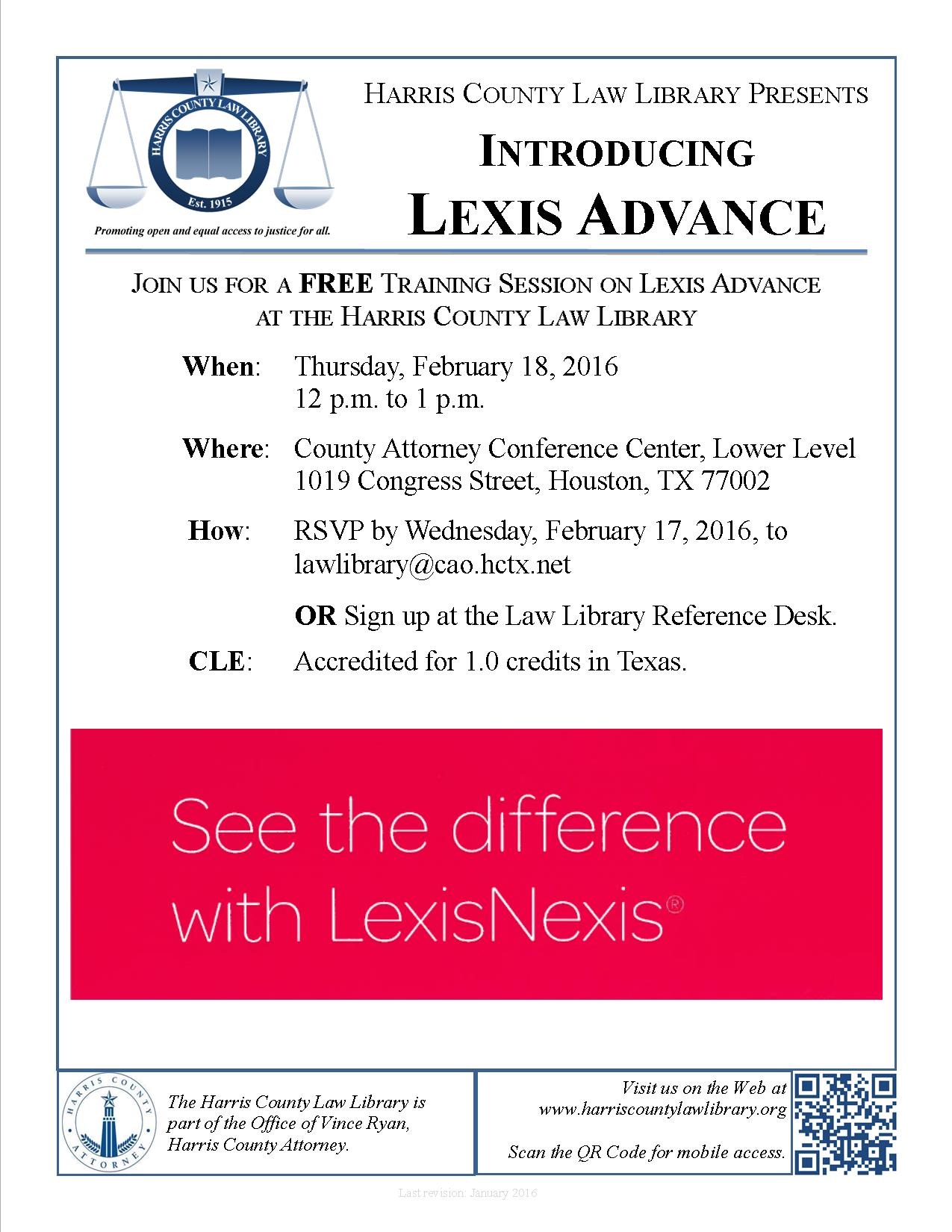
On Thursday, Feb. 18, the Law Library will host a free training session titled Introducing Lexis Advance. The session carries 1.0 hour of CLE credit for Texas attorneys and is conveniently scheduled during the lunch hour, from noon to 1 p.m.
The Law Library hosts Lexis Advance training sessions quarterly. For more information about CLEs and training sessions at the Harris County Law Library, visit our Events page.
All of the databases covered during training sessions are accessible for free on the Law Library’s legal research computers, which are open to the public for legal research. Visit Our Services page for more information about the digital resources available for your legal research needs.