


Streaming services are more popular than ever, and despite screen fatigue from attending so many work and social activities online, Massive Open Online Courses or MOOCs are experiencing a surge in enrollment. Listed here are a number of courses for lawyers and/or those interested in the law.
Read moreFree Virtual Legal Aid for Texas Veterans All Week


Tomorrow is Veterans Day. One hundred and two years ago, at the 11th hour of the 11th day of the 11th month, a cease fire was called between Germany and the Allied nations in World War I. That “armistice” held for seven months, until the Great War formally ended on June 28, 1919, outside Paris at the Palace of Versailles. Later that year, President Wilson declared November 11 a national commemoration of the armistice. In 1938, Congress established it as a federal holiday to honor the brave American veterans of that “war to end all wars.” However, after subsequent wars created new veterans, the holiday’s scope was expanded to all American veterans in 1954.
Texas has the second-largest population of veterans in the nation, and approximately 8,000 of them receive legal aid each year.
TexasLawHelp.org is promoting and running special legal aid programs for veterans all week. Please check out their impressive array of offerings by clicking here.
Civil Rights and Social Justice

The Civil Rights Act of 1964 marked the culmination of what was perhaps the most critical and momentous period in American history in the fight for equality and in the recognition of the personal freedoms and liberties granted in and guaranteed by the U.S. Constitution. Key amendments, such as the Thirteenth, Fourteenth, and Fifteenth Amendments, sought to curb rampant discrimination based on race or color. The realization of these civil rights, though, was hampered by state laws and federal court opinions that gave a green light to laws and practices based upon racial segregation and the notion that “separate but equal” was sufficient to satisfy the equal protection of the law assured by the Fourteenth Amendment. It would be decades before Brown v. Board of Education would offer some hope that racial segregation would be eliminated and that all people would truly be created equal. Unrest, coupled with Freedom Rides, sit-ins and peaceful marches in the 1950s and 1960s, provided the catalyst for one of the most important pieces of legislation in the era, the Civil Rights Act of 1964. The Act prohibited discrimination on the basis of race, color, religion, sex, or national origin and paved the way for additional legislation and protections. The struggle for equality did not end with the passage of the Civil Rights Act of 1964; it continues today with the quest for greater protection and equality for Black people, members of the LGBT community, and the disabled.

For those interested in learning about the origins of civil rights and liberties and its evolution throughout history, HeinOnline has created a new database: Civil Rights and Social Justice. Researchers are treated to a wide array of publications that capture the spirit of the era, including committee prints, CRS and GAO reports, hearings, legislative histories, and Supreme Court briefs. There are also reports made to or on behalf of the United States Commission on Civil Rights, the agency tasked with studying alleged discrimination and advancing civil rights through investigation, research, and analysis. CRS reports cover such topics as affirmative action and diversity in public education, congressional redistricting and the Voting Rights Act, “Don’t Ask, Don’t Tell,” enemy combatant detainees, and hate crime legislation. Users interested in viewing compiled legislative histories of key civil rights legislation are in luck because HeinOnline provides access to legislative histories of such laws as the Age Discrimination in Employment Act of 1967, the Americans with Disabilities Act of 1990, the Civil Rights Act of 1964, and the Equal Employment Opportunity Act of 1972. Another highlight of the database is the “Statement of Essential Human Rights,” a project of the American Law Institute begun in the 1940s to address key issues raised in the aftermath of World War II. Its appearance in the database represents the first time that the Statement has been available digitally. Users can also find related scholarly articles from law reviews and journals as well links to external sources, such as the Civil Rights Litigation Clearinghouse, the Disability Rights Education and Defense Fund, and the Southern Poverty Law Center.
For more information about the database and researching on HeinOnline, be sure to check out the associated LibGuide. There, you will find an explanation of the difference between civil rights and civil liberties, a outline of the major legislative protections, and a summary of the content available on the Civil Rights and Social Justice database. Search tips and training materials are also available.
For information on acquiring remote access to HeinOnline, check out this blog post from September 15, 2020.
Lexis Training: October 22 and On-Demand


Join us on Thursday, October 22, for a webinar from LexisNexis. This virtual Vendor Visit will be a one-hour continuing legal education session called Navigating the New Town Square: Cultivating Competency in Basic Online Legal Research. The goal of the course will be to assist attorneys in navigating online legal research so they feel more confident and competent when researching subjects important to their work. Texas attorneys can earn 1.0 hour CLE. To enroll, please visit the registration page on the Legal Tech Institute course calendar.
For additional LexisAdvance training, consider subscribing to the LexisNexis Legal YouTube channel where you can watch on-demand videos from the comfort of your desk. Videos cover a wide range of topics to help you become more adept at using this powerful legal research platform. Selected topics include:
Starting Your Search
Searching and Navigating Treatises
Exploring Content
Document and Navigation Tools
Managing Search Results
Natural Language Searching
Terms & Connectors
Using Annotated Forms
For additional guidance, explore the LexisNexis Digital Library video playlist where you can learn to more effectively navigate the LexisNexis ebook collection. The Harris County Law Library is a happy to provide access to this indispensable collection for all interested library users. Simply submit a request for access to the Lexis Digital Collection, and we will send you logon credentials as quickly as we can. Then, sign in to explore an expansive collection of Lexis treatises and practice guides, including Dorsaneo’s Texas Litigation Guide and the Texas Transaction Guide.
Don’t forget: Join us this Thursday, October 22, to build your proficiency in using LexisAdvance, and earn one hour of Texas CLE credit for attending. Hope to see you there!
Early Voting in Harris County Begins!

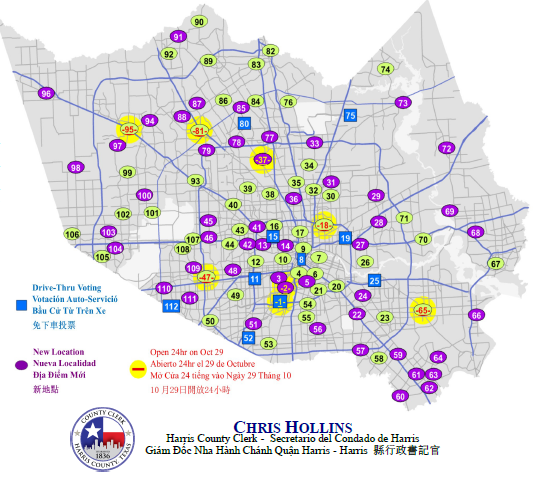
Today, October 13, 2020, is the first day of early voting in Harris County. To find the early voting location near you, visit HarrisVotes.org where you will see a listing of all locations across the county, along with their posted hours of operation. Conveniently, you will also find the estimated wait time for any particular polling site simply by selecting your desired location on the map. Approximate wait times are updated regularly, in some cases, as frequently as every 15 minutes.
If your chosen early voting location has an especially long line, it will be identified with a red map marker. Nearby voting locations will be suggested for your convenience so you can avoid waiting in long lines. Locations with shorter wait times will be identified with green map markers. Look for these indicators to save time as you plan your visit to the polls.
Don’t forget to find your sample ballot online prior to visiting the polls. Wear your face mask, and bring an approved voter ID, as both are required by all who intend to cast a ballot.
Early voting ends on October 30. Don’t miss your chance to be part of the democratic process in this year’s elections.
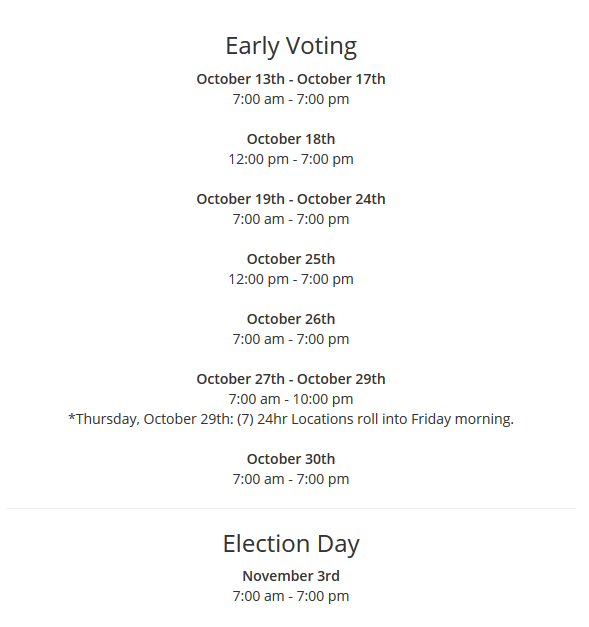
If you prefer to vote from your car, be aware that Harris County will also offer drive-thru voting at ten locations around the Greater Houston Area:
HCC West Loop South, 5601 West Loop South
NRG Arena, 1 NRG Parkway
Resurrection Metropolitan Community Church, 2025 West 11th St.
Toyota Center, 1510 Polk St.
Kingdom Builders Center, 6011 West Orem Drive
Houston Community College Alief Center, 13803 Bissonnet St.
Houston Food Bank, 535 Portwall St.
John Phelps Courthouse, 101 South Richey St., Pasadena
Fallbrook Church, 12512 Walters Road
Humble Civic Center, 8233 Will Clayton Parkway, Humble
For all other voting information in Harris County, visit the County Clerk online or call 713-755-6965. This Voting FAQ page may also provide the answers you seek. See you at the polls!