Monthly Feature: Summertime and the Law

During the month of July, Harris County Law Library is celebrating summer! Our exhibit, Summertime and the Law, will be on display all month long. On your next visit, pause for a moment in the Law Library lobby to view the exhibit and take a whimsical look at law and some of the hallmarks of summer -- sunshine, swimming, theme parks, barbecue, swimming, and more.

Featured items in the exhibit, along with a few additional sources, are listed here:

Cases

Gabriel Gomez v. The State of Texas, Unpublished

Gabriel Gomez appealed his conviction for aggravated assault asserting that he was denied a fair trial. In his complaint, Gomez described the State’s closing remarks as childish, improper, and prejudicial, and “an embarrassment to the legal dignity of the Court.” A portion of the prosecutor’s closing statement, which referenced various Disney characters, including Mickey Mouse, Peter Pan, Snow White, and the Seven Dwarves, is quoted in the opinion. See pages 6 and 7.

Animal Legal Defense Fund v. U.S. Department of Agriculture, 789 F. 3d 1206 (2015)

Living in captivity at a Florida theme park called Seaquarium, an orca named Lolita was exposed to persistent ultraviolet radiation from the sun. Seaquarium tried to combat the harmful UV rays by applying a black-colored zinc oxide to Lolita’s skin, the physiological effects of which were untested and unknown. Plaintiffs argued that the park should be denied renewal of its operating license for violating the Animal Welfare Act. 

Kingsford Products Company v. Kingsfords, Inc., 715 F. Supp. 1013 (1989)

The plaintiff, a manufacturer of charcoal briquettes, brought action against the similarly named Kingsfords, Inc. seeking to enjoin the defendant’s further use of the Kingsford mark on their barbecue sauce product. The District Court held that, despite the plaintiff’s aspirations to one day produce and sell a barbecue sauce under the Kingsford name, they were not entitled to trademark protection. The defendant had already established its product, developed from a family recipe, and the associated brand, so the plaintiff’s arguments went up in proverbial smoke.

Federal Regulations

Code of Federal Regulations, Title 21 - Food and Drugs, Part 135 - Frozen Desserts, Subpart B, Section 135.110

Code of Federal Regulations, Title 7 - Agriculture, Part 58 - Grading and Inspection, Subpart B, Section 58.649

State Statutes

Amusement Ride Safety and Inspection and Insurance Act, Vernon's Texas Code Annotated, Occupations Code, Chapter 2151. Regulation of Amusement Rides

Patents

Water Wings (1918), Patent No. 1,262,296

Water Wings (1928), Patent No. 1,677,083


On this Day: Magna Carta and the Universal Declaration of Human Rights

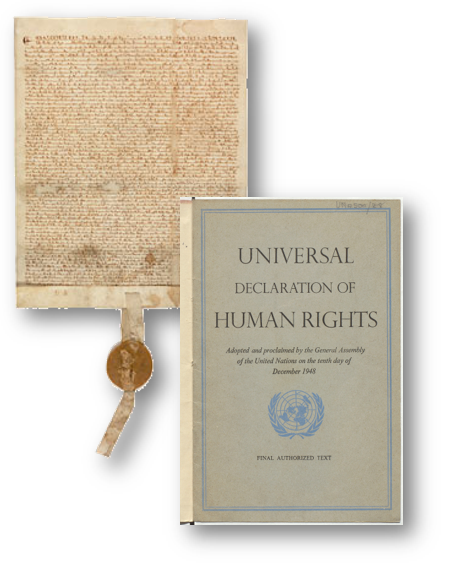
On June 15, 1215, the Magna Carta was signed at Runnymede meadow in Surrey, England. View our digital exhibit to learn more about this historic document and its role in shaping our democracy.

Many of the fundamental values we cherish, including liberty, equality, and freedom from tyranny, are direct descendants of the rights established by the Magna Carta more than 800 years ago. These ideals are embodied in our nation's founding documents and embraced by people around the world, even in countries whose governments deny any such protections to their citizens.  

Following World War II and the atrocities it spawned, an effort unfolded in the United Nations to codify the inalienable rights of people everywhere. The Human Rights Commission was established in 1946 as a standing body of the UN to draft the defining document. Two years later, on December 10, 1948, the Universal Declaration of Human Rights (UDHR) was adopted. Nearly every country in the world accepted the 30 articles that comprise the UDHR and integrated them into their bodies of law. The UDHR, which some have described as the Magna Carta of the modern age, remains a powerful instrument today, and its impact continues to be felt all over the world. 

The American Flag: 240 Years of History

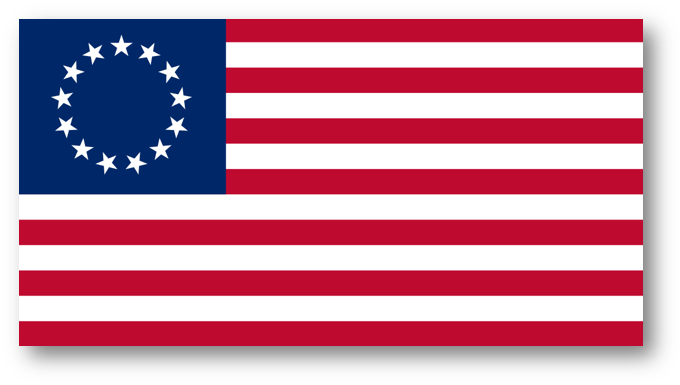
On this day in 1777, nearly two and a half centuries ago, the Stars and Stripes (pictured at right) was adopted as our national flag. While the Second Continental Congress was meeting in Philadelphia to draft the Articles of Confederation, the assembly interrupted its task to pass a resolution. It stated that “the flag of the United States be 13 stripes, alternate red and white” and that “the union be 13 stars, white in a blue field, representing a new constellation.”

This design differed greatly from an existing banner, the Continental Colors, which was promoted by George Washington early in the Revolutionary War as our unifying flag. It featured alternating red and white stripes for the 13 colonies and a British Union Jack in the upper left-hand corner, a design which reflected the ideological factions of the time -- radicals eager to claim independence and loyalists still hoping for some harmony with the crown. To proclaim its coveted sovereignty, however, the Continental Army needed a more appropriate symbol, an emblem that would unify its effort for independence, hence the design and adoption of the Stars and Stripes (also known as the Betsy Ross Flag) on June 14, 1777.

As the country grew, the flag kept pace. New stars were added for each new state in the Union, until, at the dawn of World War I, the flag's design contained 48 stars. Once again, it served as a unifying symbol for the American people, some of whom sympathized with Britain and France and others who favored Germany. In an effort to heal the growing division within our nation, and to prevent polarization of sentiment, President Woodrow Wilson, issued Proclamation 1335, which established the celebration of Flag Day as June 14th: 

Many circumstances have recently conspired to turn our thoughts to a critical examination of the conditions of our national life, of the influences which have seemed to threaten to divide us in interest and sympathy, of forces within and forces without that seemed likely to draw us away from the happy traditions of united purpose and action of which we have been so proud, It has therefore seemed to me fitting that I should call your attention to the approach of the anniversary of the day upon which the flag of the United States was adopted by the Congress as the emblem of the Union, and to suggest to you that it should this year and in the years to come be given special significance as a day of renewal and reminder, a day upon which we should direct our minds with a special desire of renewal to thoughts of the ideals and principles of which we have sought to make our great Government the embodiment.

Happy Flag Day!