

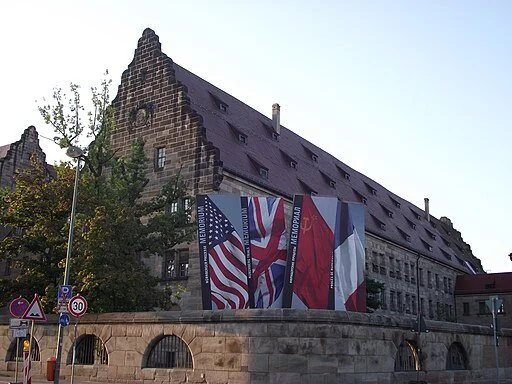
On Tuesday, October 1, 1946, those traveling the road to justice - defendants, prosecutors, and witnesses alike - reached their final destination. After 218 days, 22 men* would learn of the fate that awaited them. Following remarks by defendants on August 31, 1946, the International Military Tribunal (IMT) adjourned to consider its judgment in a trial that began on November 20, 1945.
On Monday September 30, 1946, the court reconvened. The judges arrived in black, bulletproof cars to the sound of siren wails. The buzz and activity of the trial became an eerie stillness as the courtroom awaited the verdicts. The judges first read their legal reasoning, then their verdicts on the organizations, followed by their justifications for their decision. American Experience. The Nuremberg Judges.
In determining whether the organizations named in the indictment were criminal, the IMT examined the role each organization played in actions deemed criminal by the IMT and the criminality of its members. The IMT declared the following organizations to be criminal under Article 9 of the Constitution of the International Military Tribunal: the Leadership Corps of the Nazi Party, the Gestapo (the Secret State Police), the SD (the Security Service), and the SS (the Protection Squad). There were no such findings as to the SA (the Stormtroopers), the Reich Cabinet, and the General Staff and High Command of the Armed Forces.
The following day, October 1, 1946, Sir Geoffey Lawrence, President of the IMT pronounced the guilt or innocence of each defendant and the reasons for such judgment. Hermann Goering, Joachim Von Ribbentrop, Wilhelm Keitel, Alfred Rosenberg. Alfred Jodl, and Konstantin Von Neurath were found guilty on all four counts named in the indictment. Wilhelm Frick, Walther Funk, Arthur Seyss-Inquart, and Erich Raeder were found guilty on three of the four counts. Rudolf Hess, Ernst Kaltenbrunner, Hans Frank, Martin Bormann, Karl Doenitz, Fritz Sauckel, and Albert Speer each were found guilty on two counts. Julius Streicher and Baldur von Schirach were each found guilty on Count 4, crimes against humanity. The IMT acquitted Hjalmar Schacht, Franz von Papen, and Hans Fritzsche. Of those convicted, 12 were sentenced to death by hanging. The remaining defendants were sentenced to prison terms of varying lengths in Spandau Prison in Berlin.
On October 16, 1946, 10 of the 12 sentenced to death were hanged in the gymnasium of the Nuremberg Prison, “cremated in Dachau, and their ashes dropped in the Isar River. Hermann Goering, second only to Hitler in the Nazi regime, escaped the hangman's noose by committing suicide before his execution.” Defendant Martin Bormann was never punished for his crimes.
By the Numbers
Throughout the months-long trial, prosecutors and judges perused and analyzed a considerable amount of documentary evidence, listened to and contemplated hours of oral testimony and arguments, and otherwise conducted the procedures related to the trial. From a data perspective, the President of the IMT summarized the Nuremberg Trial as follows:
403 open sessions of the IMT were held;
33 witnesses gave evidence orally for the prosecution;
61 witnesses and 19 defendants gave evidence for the defense;
143 additional witnesses gave evidence for the defense by means of written interrogatories;
101 witnesses were heard for the defense before tribunal-appointed Commissioners;
1,809 affidavits were submitted;
6 reports summarizing contents of other affidavits were submitted;
38,000 affidavits signed by 155,000 people were submitted on behalf of the Political Leaders; 136,312 on behalf of SS; 10,000 on behalf of the SA; 7,000 on behalf of the SD; 3,000 on behalf of the General Staff and OKW (Armed Forces High Command); and 2,000 on behalf of the Gestapo;
22 witnesses gave evidence for the organizations;
Several thousand documents were offered in evidence for the prosecution, consisting of approximately five million words; and
6 defendants were found guilty on all counts, 13 guilty on some, and three innocent.
Between December 1946 and April 1949, an additional 12 military tribunals were convened. Of the 177 defendants tried for war crimes in those proceedings, 24 were sentenced to death. Twenty-five were acquitted, and the remaining received varying prison sentences.
International Holocaust Remembrance Day
It is only fitting that we conclude our short series documenting the anniversary of the first Nuremberg Trial on this day. Today and each January 27 is set aside for International Holocaust Remembrance Day, a day on which we commemorate the millions of victims who suffered at the hands of the men who were convicted following this historic trial. In a resolution issued on November 1, 2005, the United Nations designated January 27 as International Day of Commemoration in memory of the victims of the Holocaust and urged its member nations to “develop educational programmes that will inculcate future generations with the lessons of the Holocaust in order to help to prevent future acts of genocide.” The date chosen for this remembrance marked the anniversary of the 1945 liberation of the Auschwitz-Birkenau Concentration Camps by the Soviets. Here, in Houston, the Holocaust Museum Houston “will commemorate and honor the six million Jews and other innocent victims of the Holocaust with free admission on Tuesday, January 27.”
Further Reading
The National World II Museum New Orleans - The Nuremberg Trials
Yale Law School Lillian Goldman Law Library - The Avalon Project: Documents in Law, History and Diplomacy
PBS.org - American Experience The Nuremberg Trials
United States Holocaust Memorial Museum - Holocaust Encyclopedia Nuremberg Trial Verdicts
UMKC School of Law - The Nuremberg Trials: Newspaper Accounts
*The initial indictment filed on October 18, 1945 named 24 defendants. One defendant, Robert Ley, committed suicide on October 25, 1945, and another defendant, Martin Bormann, was tried in absentia.