

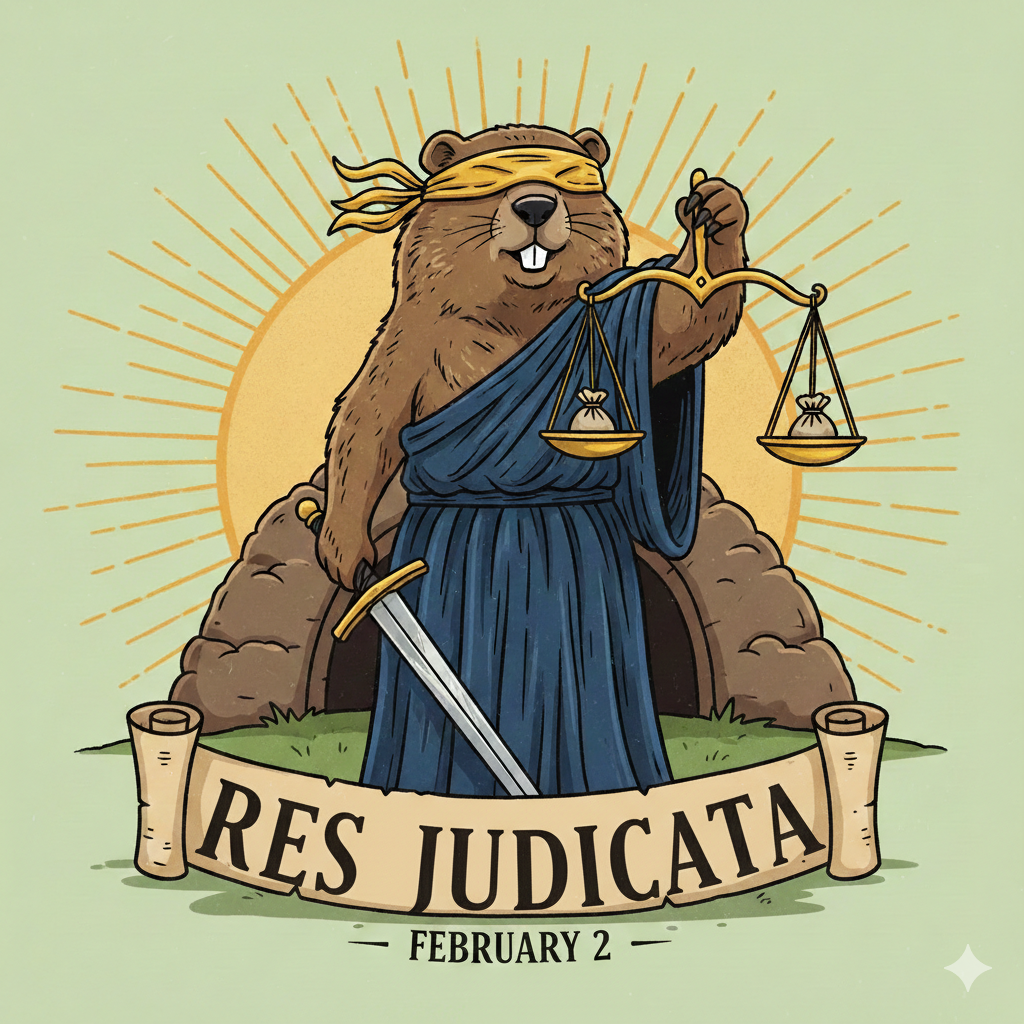
Image Source: Nano Banana/Google Gemini AI
In the 1993 movie Groundhog Day, Bill Murray’s character wakes up at 6:00 am, with “I’ve Got You, Babe” playing on his clock radio, over and over, in an endless loop. Every day is the same day, repeating again…and again…and again. In law, something similar can happen when parties try to relitigate disputes that have already been decided. To prevent this kind of rehashing, courts rely on a doctrine called res judicata.
Res judicata plays a critical role in maintaining fairness, efficiency, and finality in the legal system. Without it, courts could be overwhelmed with repeat lawsuits, and parties could never truly move on from resolved disputes.
This article explains what res judicata is, how it works, and how related terms—like collateral estoppel, issue preclusion, claim preclusion, and final judgment—fit into the picture.
What Is Res Judicata?
Res judicata is a Latin term that means “a matter already judged.” In plain terms, it is a legal doctrine that prevents the same parties from litigating the same claim more than once after a court has issued a final decision.
Once a case has been fully decided, res judicata bars the parties from bringing another lawsuit based on the same underlying dispute.
The purpose is threefold:
Finality – At some point, litigation must end.
Fairness – Parties should not be harassed by repeated lawsuits.
Efficiency – Courts should not spend time deciding the same disputes again and again.
This is how the law avoids the “groundhog day phenomenon” of cases repeating indefinitely.
Claim Preclusion: The Core of Res Judicata
Res judicata is often used interchangeably with claim preclusion, which is its most common application.
Claim preclusion generally applies when the same parties (or those in legal privity with them) are involved, when the same claim or cause of action is being asserted, and when a final judgment on the merits in the earlier case has been rendered. If all three elements are met, the subsequently filed case will usually be dismissed.
Importantly, claim preclusion covers not only claims that were actually raised in the first lawsuit, but also claims that could have been raised and arose from the same transaction or occurrence.
What Is a Final Judgment?
A key requirement of res judicata is that the earlier case must have ended in a final judgment on the merits.
A final judgment generally means:
The court has issued a decision that fully resolves the case, and
The decision is no longer subject to ordinary appeal (or the time to appeal has passed).
A judgment “on the merits” usually means the court decided the substance of the dispute, not just a technical or procedural issue.
Examples that often count as final judgments:
A judgment after trial
Summary judgment
A dismissal with prejudice
Examples that usually do not count:
A dismissal without prejudice
A case dismissed for lack of jurisdiction
A case dismissed for improper service
Issue Preclusion and Collateral Estoppel
Res judicata has a close cousin called collateral estoppel, also known as issue preclusion.
While claim preclusion prevents entire claims from being relitigated, issue preclusion prevents specific issues of fact or law from being relitigated.
Issue Preclusion (Collateral Estoppel) applies when an issue was actually litigated in a prior case, the issue was essential to the prior judgment, and the issue is raised again in a later case involving the same party (or, in some circumstances, a related party).
For example, if a court has already decided that a contract is valid, a party generally cannot later bring a new case and argue that the same contract is invalid.
How These Doctrines Work Together
Think of it this way:
Res judicata/claim preclusion stops the entire lawsuit from happening again.
Collateral estoppel/issue preclusion stops specific decided issues from being reopened, even in a different lawsuit.
Together, they ensure that once a court has spoken definitively, its decision carries lasting weight.
Why Res Judicata Matters
Res judicata protects litigants, by providing closure and certainty; courts, by conserving limited judicial resources; and the legal system, by reinforcing respect for final judgments.
Without it, litigation could become endless, expensive, and deeply unfair—exactly the kind of legal “Groundhog Day” the doctrine is designed to prevent.
A Note for Self-Represented Litigants
Res judicata can be confusing, especially for people representing themselves. A case being dismissed because of res judicata does not mean the court thinks the claim is unimportant. It usually means the court believes the issue has already been decided and cannot be reopened.
Understanding whether a prior case involved the same parties, claims, and a final judgment can be critical before filing a new lawsuit.
If you would like to learn more about res judicata and the related legal concepts described above, you may wish to consult the following resources, online, at the Harris County Hainsworth Law Library, or via the Texas State Law Library’s digital collections.
What is res judicata? – ThomsonReuters Glossary
Restatement of the Law, second: Judgments, 2d. – Available in print and via HeinOnline
Civil Procedure in a Nutshell (10th ed., 2026) – West Academic available via the Texas State Law Library (Register here for access)
Federal Rules of Civil Procedure – U.S. Courts (See: Rule 8-General Rules of Pleadings)